Talk Nation Radio for March 19, 2008
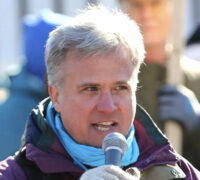
Robert Naiman on US Foreign Policy and Political Race
Listen to this week’s program here
Produced by Dori Smith, WHUS, a Pacifica Affiliate station at the University of Connecticut in Storrs, CT
TRT: 29:28
Download at Pacifica’s Audioport and at Archive.org or Radio4all.net
As we mark year five of the Iraq War we look once again at US foreign policy. The financial cost of the Iraq War is in the trillions, nearly 4,000 US soldiers are listed by the US Military as casualties, though tens of thousands have been wounded and it is not clear that they list all of the numbers of US dead. Those who die after airlift may not be reported in full but you can track the statistics at http://www.antiwar.com/casualties.

An internal Army study reported 121 soldiers committed suicide in 2007 alone. Our guest this time is Robert Naiman, Senior Policy Analyst and National Coordinator at Just Foreign Policy. A counter on their web site lists more than a million Iraqi civilian casualties.
Robert Naiman assesses the Iraq War costs in terms of civilian casualties and discusses Clinton versus Obama versus McCain policies and the current media focus on experience, race, and Obama’s former pastor, Rev. Jeremiah Wright.
For a full download of one of Rev. Wright’s speeches click here for the Amherst College web site. The Feb. 9, speech was given in Johnson Chapel at Amherst College. Their web site refers to him as “a stirring speaker.”
Isn’t this really a question of Wright touching on the existing anger about US policies at home? Is it even legal in Bush’s America to mention that US policies abroad provoke terrorism? What would disillusioned US soldiers think about Wright’s speeches? Can Barack Obama unite angry Black, White, Latino, and all other US voters where they too are angry? We hear longer segments of Wright’s state of the dream speech plus a clip from Homeland Security chief Michael Chertoff who says US policies don’t have anything to do with provoking terrorism. They attack us because we are ‘weak’ he told media expert Sam Husseini.
Just Foreign Policy http://www.Justforeignpolicy.org is an independent and non-partisan mass membership organization working to reform U.S. foreign policy. Robert Naiman explained that of the two leading democratic Presidential candidates, Hillary Clinton and Barack Obama’s positions are more in keeping with the views outlined on their web site, but they are not supporting him.
The group consists of economists, foreign policy experts, sociologists, writers and activists including former member of Congress Tom Andrews of Win Without War, NAACP and University of Virginia History professor Julian Bond, Lisa Hoyos, President of the board for the California coalition for fair trade and human rights, peace activist and writer Tom Hayden, and others. They point out that at the height of the Vietnam War in 1968, the U.S. gross federal debt was 43.5 percent of our economy and falling. Today it is over 67 percent and rising. Maintaining our current foreign and military policy and possible large increases in military spending (for example if we have an arms race with China, whose economy will be larger than ours within a decade) will lead to serious declines in U.S. living standards. They say U.S. foreign policy therefore threatens to impede—perhaps as never before—the country’s economic and social progress. It has become extremely important to the lives of all Americans, and we cannot afford to leave it in the hands of the “experts” without influence from the public.
Commentary
As political pundits all across the country continue to talk about whether or not Democrat Barack Obama opened up a major discussion on race in America, whether or not he can articulate a message that will resonate with voters of various races and ethnicities, let’s look at the question of foreign policy that Robert Naiman raised.
Barack Obama made a fascinating speech at Fort Bragg in South Carolina (See story, transcript not yet available) where he said US foreign policy under the Bush administration has emboldened al-Qaida, the Taliban, Iran and North Korea. This is in fact an opinion that has been shared by US political scientists and US intelligence analysts. (see: NYT, Sept. 24, 2006, By MARK MAZZETTI, “A stark assessment of terrorism trends by American intelligence agencies has found that the American invasion and occupation of Iraq has helped spawn a new generation of Islamic radicalism and that the overall terrorist threat has grown since the Sept. 11 attacks.” also see Zfacts) (More info below)
But here is one of the clips of Rev. Wright that was aired by ABC that caused such a stir:
“We bombed Hiroshima, we bombed Nagasaki and we nuked far more than the thousands in New York and the Pentagon and we never batted an eye. We have supported state terrorism against the Palestinians and Black South Africans and now we are indignant because the stuff we have done overseas is now brought right back into our own front yards. Americas chickens are coming home to roost.”
ABC created a kind of montage of Wright’s statements.
In fact Rev. Wright’s heated commentary was at times about the idea that US foreign policies abroad over long years of various wars has actually provoked acts of terror. We air portions of his speeches that were put together in a montage by ABC to showcase his angry moments. But Wright’s full remarks do not come across as any kind of ‘hate speech’ at all, which is what he was accused of by the extreme right. He seems to be urgently trying to express what he sees as the truth, that the US is suffering the consequences of policies that have harmed and provoked others in places like the MidEast and Indochina.
That view is not uncommon in the US and a wide variety of people share it, yet FOX, CNN, ABC and MSNBC have treated it as an aberrant idea.
This seems more like a test of free speech under new interpretations of the constitution by George Bush, Dick Cheney, and Michael Chertoff at Homeland Security. I want to turn back the clock a little bit to an August 2006 show with media and foreign policy expert Sam Husseini who caught up with Homeland Security Chief Michael Chertoff and asked him if he thought some aspects of US foreign policy might be contributing to violence against US troops or even terrorism. This is what Chertoff said:
“History teaches us we do not provoke terrorism. What tends to foster terrorism is when the terrorists think we are weak.”
The question of a public perception that America is weak as a precipitating factor is interesting; following Chertoff’s logic, America has been far more vulnerable to terrorism today than before 9/11 since the Iraq and Afghan wars have put the country into major debt and drained US forces; also there is the economic crisis in the US.
But this is what Sam Husseini had to say back in 2006:
“In 1982 Israel bombing Beirut and bringing down buildings and so on much as what just recently happened Bin Laden basically said if they are going to do this to our people we are going to do this to their people.”
Within the ‘he said she said’ campaign being run by news anchors of CNN, ABC, FOX and other networks America does seem very divided, however, polls also indicate that Americans agree on the devastation of Hurricane Katrina and the Bush administration’s failures and on the anger they feel about the deceptions of the White House on Iraq. Americans are clearly divided over the Iraq War, and over what should constitute foreign policy in general and the question is which candidate can unite the most voters in November? At one end of the spectrum are die hard supporters of the war who support escalation, versus those who want to see US troops come home now.
Within these two groups there is passion and at times even rage. That is what Rev. Wright seems to have hit on in his speeches, and when you listen to them in full you can hear the voices of many Americans, of soldiers who have been through war and want nothing more than peace unless it’s justice.
Wright’s appeal to those who feel burned by the Bush White House seems clear, but will Barack Obama be able to reach out to a wide enough variety of people who fall into that category. How would Wilton Sekzer perceive him for instance? In a March 15 piece in the New York Times, Jim Dwyer writes that Wilton Sekzer, a retired New York City police officer and Vietnam Veteran who lost his son Jason on 9/11 was at first so gung ho about the Iraq War that he wrote letters to the Military asking that his son’s name be scratched on a bomb that was dropped in Iraq. –Now Sekzer regrets this act, and he told the Times he was furious to learn that there was no link between Iraq and 9/11 or Al Qaeda.
Let’s listen to a longer segment of a speech by Rev. Jeremiah Wright: Click here for audio in Mp3 format of the Rev. Dr. Jeremiah A. Wright, Interfaith Service Celebrating the Rev. Dr. Martin Luther King, Jr., February 9, 2007
(See last nine minutes of Wright’s speech.)
https://cms.amherst.edu/news/eventsmultimedia/2007/node/17062
http://www.whus.org to listen live Wed. at 5 PM
talknationradio@gmail.com is our email address. Write to us with your comments and story ideas or for information on how you can air this free weekly broadcast through Pacifica.org or Archive.org and Radio4all.net
Is U.S. Safer Since 9/11? Clinton and Rivals Spar
By MICHAEL COOPER and PATRICK HEALY
Published: June 6, 2007
“The question of whether the nation is safer than it was before the Sept. 11 attacks is debated passionately among policy makers and security experts. A survey of more than 100 foreign policy experts, conducted in February by Foreign Policy magazine, for instance, found that three-quarters believed that the United States was losing the war on terror.
Some cite the fact that there have been no domestic terror attacks since Sept. 11, and the foiling of several alleged terror plots, as evidence that the new antiterrorism measures are working. They credit the heightened security measures at airports and in cities across the nation, and the revamping of the nation’s intelligence agencies.” (continues)